BETA
*Portion Sizes
This calculator uses typical serving sizes based on the average consumer's eating habits:
Beef – 1 steak • 5.3 oz (150 g)
Lamb – 1 serving • 4.2 oz (120 g)
Pork – 1 serving • 4.2 oz (120 g)
Poultry – 1 serving • 4.2 oz (120 g)
Salami, hams – about 2 slices • 2.1 oz (60 g)
Fish – 1 fillet • 4.2 oz (120 g)
Shrimps / clams – about 6 shrimps • 2.1 oz (60 g)
Eggs – 1 egg • 2.1 oz (60 g)
Yogurt / milk – ⅔ cup • 5.3 oz (150 g)
Cheese – 1 slice or cube • 1.1 oz (30 g)
Impacts and risks calculation details
It uses statistical per-kilogram data to estimate the effects of different animal protein consumption. The user enters their own portions per week for each product, which are then used to calculate total impacts.
The analysis is based on data available from Our World in Data, which draws on the Food and Agriculture Organization of the United Nations and the work of Poore & Nemecek. It also uses data from Faunalytics, the Water Footprint Network, The EU Fish Market, and the National Fisheries Institute, as well as studies on the impact of plant-based and animal-based diets on health, published on PMC or PubMed.
Animals saved
The entered portion amounts are multiplied by the estimated number of animal lives lost per kilogram of each product, including both direct and indirect deaths. This shows how many animal lives are affected by the person's diet.
CO₂e prevention
The user's portions are multiplied by the greenhouse gas emissions per kilogram of each product.
Preserving land
The entered portions are multiplied by the land area required per kilogram of each product.
Water conservation
The entered portions are multiplied by the water footprint per kilogram of each product.
Savings calculation
The potential savings for animals, CO₂e emissions, land, and water are calculated by comparing the user's current diet impact with a plant-based diet impact.
Health Concerns
The calculator estimates relative health risks by multiplying the amount of each food you eat by established thresholds linked to specific health outcomes. If your consumption exceeds a threshold (like 50 g/day of processed meat or 200 g/day of milk), the corresponding risk (such as heart disease, cancer, or mercury exposure) is flagged.
Grades calculation details
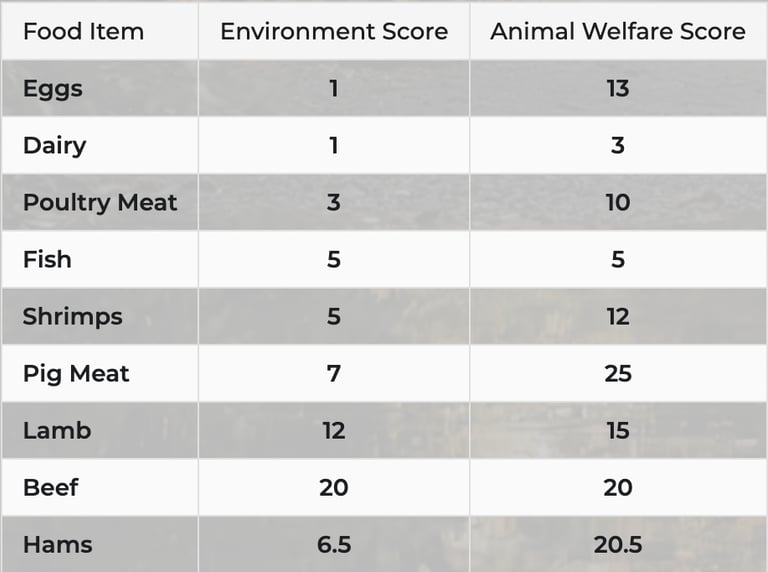
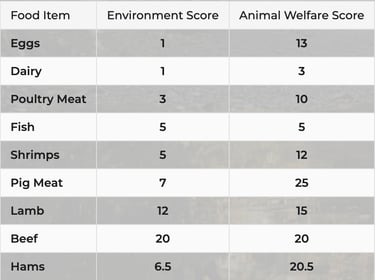
This calculator measures the impact of your diet by assigning points for the animal foods you eat each week. Eating more high-impact foods results in a higher score and a worse grade.
Beef has the worst environmental impact, emitting 99.5 kg CO₂-eq and using 326 m² of land per kg, followed by lamb at 39.7 kg CO₂-eq and 370 m². In contrast, eggs (4.7 kg CO₂-eq) and poultry (9.9 kg CO₂-eq) have far lower impacts, making them much more sustainable choices.
The worst animal welfare impacts come from pig meat, with the highest sentience at 0.48 and intensive farming, likely to experience suffering. Eggs stand out for their intensive farming, and dairy involves the longest durations of suffering (over 1,400 days).
Disclaimer: this calculator provides estimates of environmental impact, animal welfare concerns, and potential health risks based on your reported animal-food intake. It is for informational purposes only and does not replace professional medical, nutritional, or environmental advice.